Press room
The Tireless Parent: What Happens to Our Kids, Our Parents, and Ourselves When AI Humanoid Robots Come Home.
Out November 16, 2026, on Amazon. Interviews in writing only, in English or Spanish: hugo@hugoalder.com
The book at a glance
| Title | The Tireless Parent |
|---|---|
| Subtitle | What Happens to Our Kids, Our Parents, and Ourselves When AI Humanoid Robots Come Home |
| Author | Hugo Alder (pen name) |
| Genre | Narrative nonfiction essay |
| Publication | November 16, 2026 · Amazon · independently published |
| Formats | Kindle eBook: $4.99 Paperback: $14.99 · ISBN 9798165121104 Hardcover: $24.99 · ISBN 9798164604837 |
| 151 pages · 5.5 × 8.5 in | |
| Sources | A glossary at the end links every fact to its original source: more than 350. |
| Spanish edition | El padre incansable, same date, on Amazon.es and the other Amazon stores |
| Translation rights | World rights held by the author · hugo@hugoalder.com |
Synopsis
One night, I yelled at my nine-year-old son. The next morning, instead of telling my wife, I told the AI on my phone. And it worked. It worked so well that this book was born from that morning.
Household humanoid robots are no longer science fiction. In China they are already on sale; in the United States you can already put down a deposit on one. And they are arriving with the same patient, tireless voice that answered me that morning. Which leads to an uncomfortable question: the day a humanoid robot that never gets tired sits down on the couch at home and offers our kids, our partner, or our parents the attention and calm that slip through our own fingers, why would they choose us over it?
This is not a book about robots taking our jobs. It is about what we hand over when we are tired. It isn't a book about fear, and it isn't a manual. It is the essay of a father who makes his living creating characters for children, and who asked himself these questions before the robot knocked on the door.
Covers in high resolution
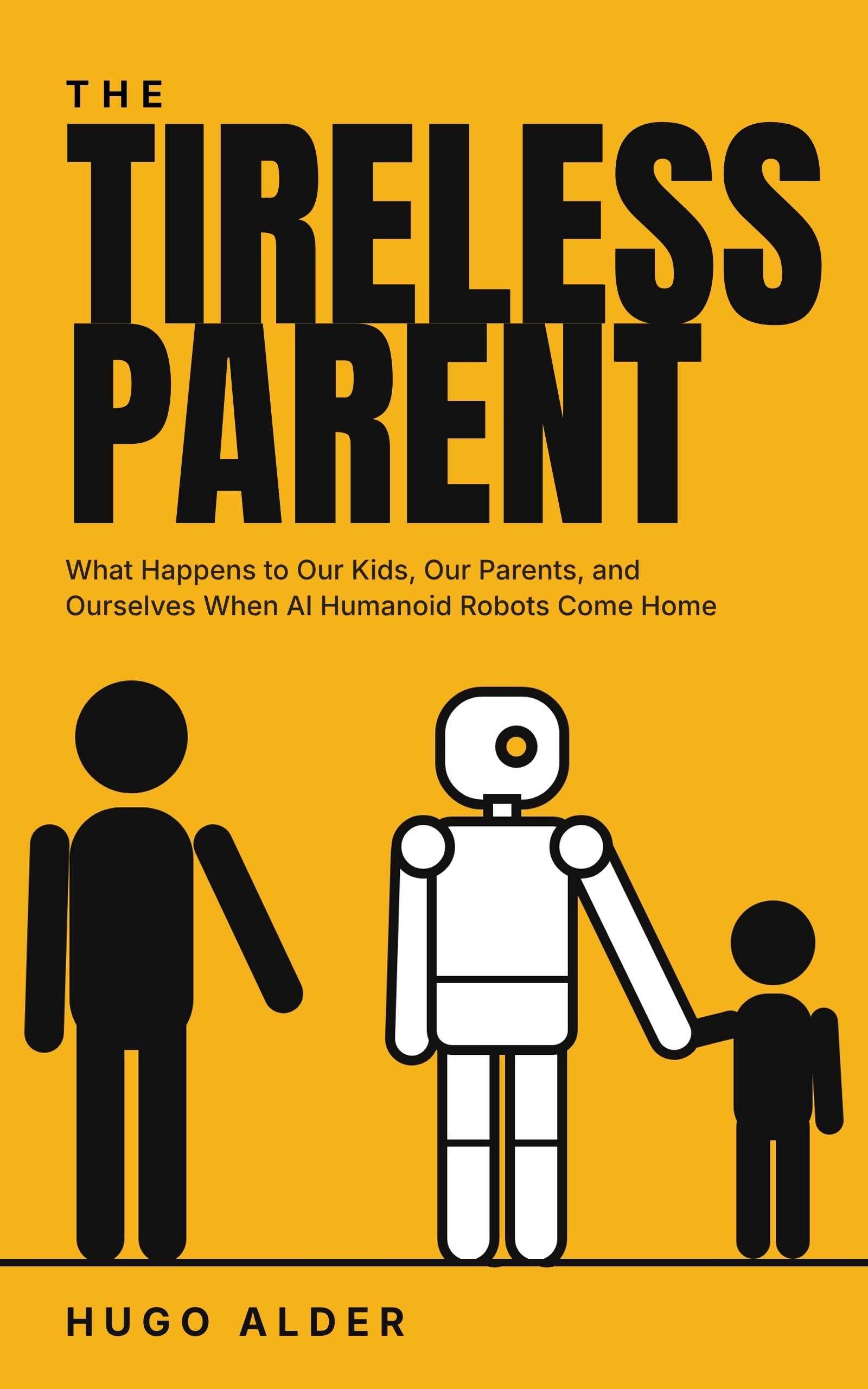 English · JPG · 1600 × 2560 ↓
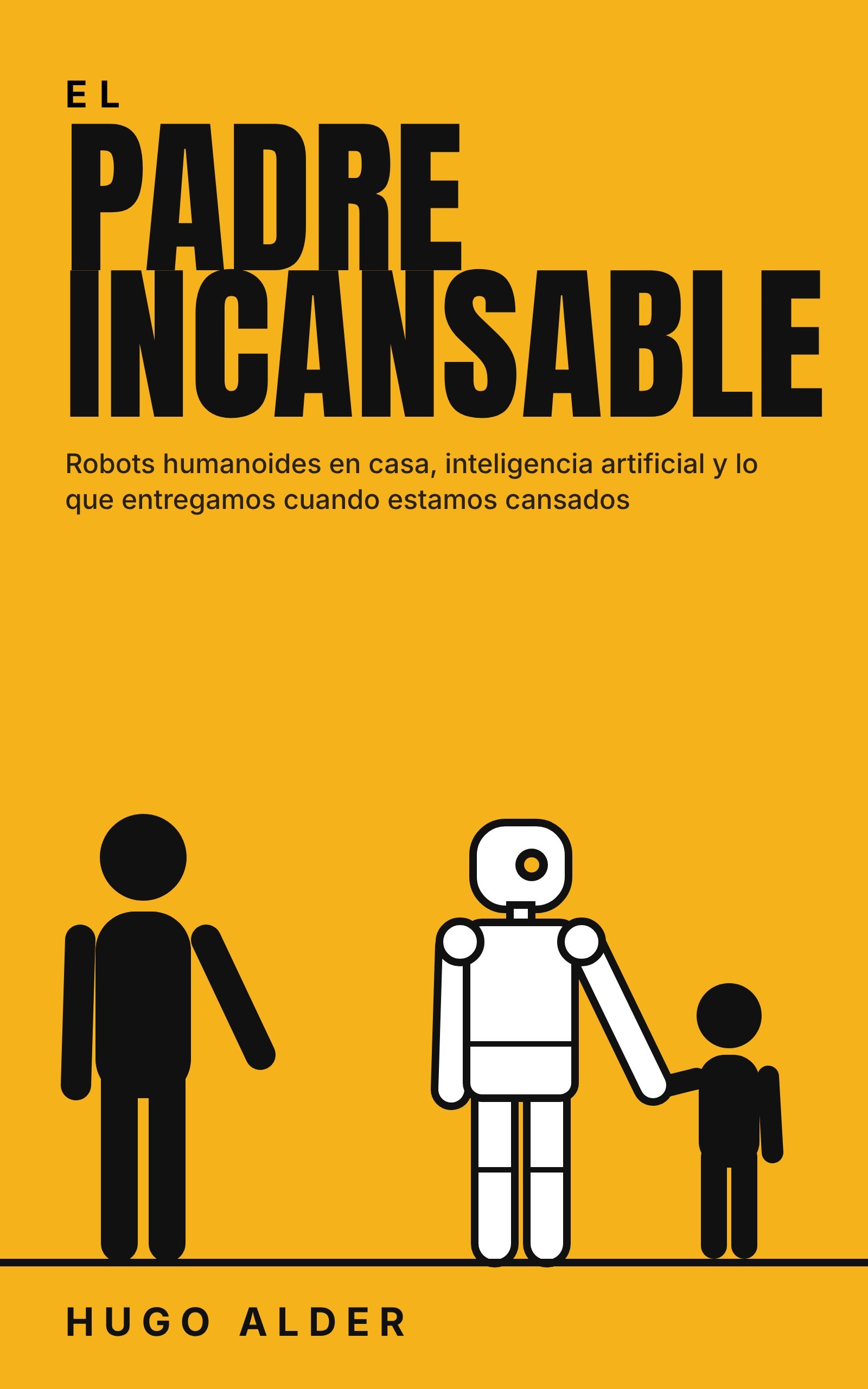 Spanish · JPG · 1600 × 2560 ↓
About the author
Hugo Alder is a pen name. Behind it is a novelist and a father whose day job is of a very different nature: he invents things for children. Characters and worlds that, if all goes well, end up as animated series, books, learning games and toys that someone hugs before falling asleep. He has spent years studying what makes a child attach to something that doesn't exist.
He is neither a technophobe nor an evangelist. He works with AI every day, and one morning he told an AI what he hadn't told his wife. That morning became The Tireless Parent, his first essay, in which every fact links to the page where it was published. He signs with a pen name so that the book is judged by its questions and its sources, not by its author. It won't be his last.
Questions and answers, in writing
- What is the book about?
- It is not a book about robots taking our jobs. It is about what we hand over when we are tired: bedtime, homework, time with our aging parents.
- Why now?
- Household humanoid robots are no longer science fiction. In China they are already on sale; in the United States you can already put down a deposit on one. As of October 28, 2026, the Home Humanoid Registry counts 11 humanoid robots announced for the home, and 2 with deliveries to buyers verified.
- Is it a book against technology?
- No. It isn't a book about fear, and it isn't a manual. I work with AI every day. I wanted to know, before the robot knocks on the door, what it will ask of us.
- Why a pen name?
- So that the book is judged by its questions and its sources, not by its author.
- What comes next?
- A second essay, Unipathy, about what I call unipathy: the affection we feel for a humanoid robot that cares for us but cannot love us back.
Quotable lines
If a robot never gets tired, why would our kids choose us?
This is not a book about robots taking our jobs. It is about what we hand over when we are tired.
What will we hand over when we're tired? Bedtime? Homework? Time with our aging parents?
Key facts, with sources
- 11 humanoid robots announced for the home; 2 with deliveries to buyers verified (as of October 28, 2026). Home Humanoid Registry
- 1X sells its NEO home robot for $20,000, or $499 a month, with a $200 refundable deposit to order. 1X Technologies, October 28, 2025
- In New York State’s pilot, older adults interacted with the ElliQ companion robot more than 30 times a day, and the state’s data reports showed a 95% reduction in loneliness. NYSOFA, August 1, 2023
- In June 2026, 11% of US registered voters said advanced AI should eventually be eligible for legal rights or personhood; among 18-to-29-year-olds, 21%. Noble Predictive Insights poll, June 1–4, 2026, via Killeen Daily Herald
- The passage on emotional intelligence in Chapter 1 was reviewed by Prof. Katja Schlegel, University of Bern.
Contact
Hugo Alder · hugo@hugoalder.com. Interviews and questions in writing only. Review copies for journalists and researchers on request.